 FishKillFlea
· Basics · 5 min read
Fishing License on Private Property (2026) — Do You Need One?
Reviewed by FishKillFlea Editorial Team
Do you need a fishing license to fish on private property? State-by-state rules for private ponds, lakes, and stocked fishing preserves.
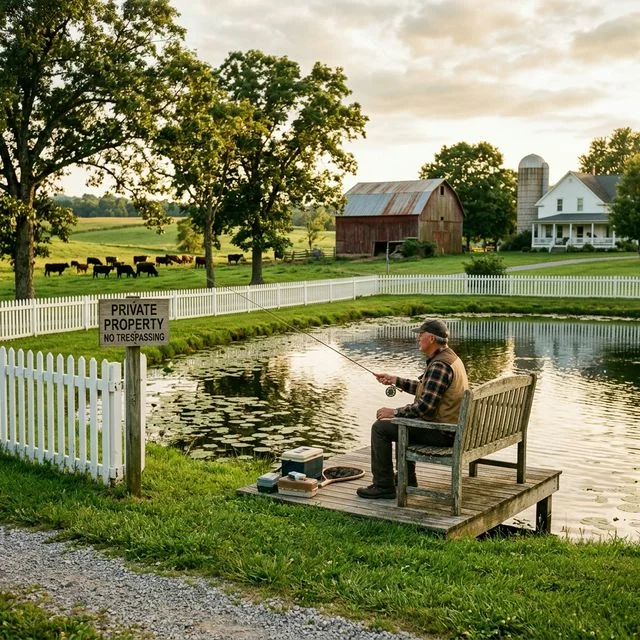
Do you need a fishing license to fish on private property? The answer varies dramatically by state — some states exempt landowners fishing their own ponds entirely, while others require a license no matter where you fish. This guide covers every scenario so you know the rules.
The Two Main Approaches
US states fall into two camps on private property fishing:
| Approach | Rule | States |
|---|---|---|
| Exemption states | No license needed to fish on your own private property | ~30 states |
| License required everywhere | License needed even on private property | ~20 states |

Pflueger President Spinning Reel
Smooth 10-bearing system. Great value for freshwater fishing.
Affiliate link · Prices may vary
States Where No License Is Needed on Private Property
These states exempt landowners fishing on their own private ponds from the license requirement:
| State | Who’s Exempt | Conditions |
|---|---|---|
| Texas | Property owner + family | Must own the land; private pond must not connect to public waters |
| Indiana | Property owner | Private lakes/ponds entirely within your property boundaries |
| Michigan | Property owner | Private ponds not connected to public waters |
| Ohio | Property owner | Private ponds on your own land |
| Pennsylvania | Property owner + family | Private ponds you own or lease |
| Virginia | Property owner on own land | Must own the land and the pond |
| Tennessee | Property owner | Private impoundments on your land |
| Georgia | Property owner + family | Farm ponds on your own land |
| Alabama | Property owner | Private ponds on your land |
| Kentucky | Property owner | Private farm ponds |
| Oklahoma | Property owner + family | Private ponds not connected to public waters |
| Kansas | Property owner | Private ponds on your own land |
| Missouri | Property owner | Private ponds that you own |
| Arkansas | Property owner | Private ponds on your land |
| Iowa | Property owner | Private ponds entirely on your property |
| Wisconsin | Property owner | Private ponds on your property |
| Minnesota | Property owner | Private ponds (not connected to public waters) |
| North Carolina | Property owner | Private ponds on your land |
| South Carolina | Property owner | Private ponds you own or lease |
| West Virginia | Property owner | Private ponds on your land |
| Nebraska | Property owner | Private ponds on your property |
| Mississippi | Property owner | Private ponds on your land |
Key condition: The pond must typically be entirely within your property boundaries and not connected to public waters (rivers, streams, public lakes).

Ugly Stik Elite Spinning Rod
Premium Ugly Stik with improved sensitivity and lighter weight.
As an Amazon Associate, we earn from qualifying purchases. Prices may vary.
States Where a License Is ALWAYS Required
In these states, you need a fishing license even on your own private property:
| State | Rule | Notes |
|---|---|---|
| California | License required everywhere | No private property exemption |
| New York | License required everywhere | Even on your own pond |
| Florida | License required | Exception: if you built/paid for the pond AND own the land |
| Colorado | License required | No private property exemption |
| Oregon | License required | Even on private land |
| Washington | License required | No exemption for private ponds |
| Montana | License required | Even on private property |
| Idaho | License required | No private exemption |
| New Jersey | License required | With some exceptions for stocked private ponds |
| Connecticut | License required | No exemption |
| Massachusetts | License required | Private pond exception if you own and stock it |

Penn Pursuit IV Spinning Combo
Rod and reel combo ready to fish out of the box. Great value for new anglers.
Affiliate link · Prices may vary
What About Guests on Private Property?
Even in exemption states, the rules for guests and non-owners are usually more restrictive:
| Scenario | Typical Rule |
|---|---|
| Property owner fishing own pond | Exempt in most states |
| Owner’s immediate family | Usually exempt (spouse, children) |
| Invited guests | Usually NEED a license — even on private property |
| Paid fishing (pay-per-fish ponds) | Typically covered by commercial preserve license |
| Tenant / renter | Varies — some states treat tenants as owners, others don’t |
Most common mistake: Inviting friends to fish your private pond and assuming they don’t need a license. In most states, guests still need a valid fishing license even on private property.
Private Stocked Fishing Preserves (Pay Lakes)
Commercial fishing preserves (pay-to-fish ponds, trout farms, catfish ponds) have their own rules:
| Type | License Needed? | How It Works |
|---|---|---|
| Licensed fishing preserve | No — in many states | The business holds a preserve license that covers all customers |
| Unlicensed private pond | Varies | If no commercial license, guests may need their own |
| Fish-out ponds (pay by the fish) | Usually no | The commercial license covers the activity |
| Private fishing clubs | Usually yes | Members typically need their own state fishing license |
States With Fishing Preserve Exemptions
| State | Preserve Exemption? | Details |
|---|---|---|
| Pennsylvania | Yes | Licensed preserve — no state fishing license needed |
| New York | Yes | Licensed preserve — preserves exempt customers |
| Ohio | Yes | Commercial fish ponds — no license needed |
| Michigan | Yes | Licensed pays lakes — customers exempt |
| Texas | Yes | Commercial aquaculture — customers exempt |
| Florida | No | License required even at commercial ponds |
| California | No | License required at all locations |
Private Lakes in Gated Communities
If you live in a community with a private HOA-managed lake, the rules get tricky:
| Scenario | License Needed? |
|---|---|
| Private lake entirely within HOA boundaries | Usually exempt (treated as private land) |
| Private lake connected to public waterways | License required in most states |
| Private lake stocked by HOA | Check state rules — the connection to public waters matters |
| Private lake with public dock/access | License required — it’s accessible to the public |
When in doubt, check with your state wildlife agency. The key factor is whether the water body connects to public waters and whether it has public access.
Frequently Asked Questions
Do you need a fishing license for a private pond? In about 30 states, property owners don’t need a license for fishing their own private pond. In about 20 states (including California, New York, Colorado, and Oregon), a license is required everywhere. See the tables above.
Do guests need a fishing license on my private property? In most states, yes — even on exemption states, guests who are not the property owner or immediate family typically need their own fishing license.
Do you need a fishing license for a pay lake? At licensed commercial fishing preserves (pay lakes, fish-out ponds), many states exempt customers from the licensing requirement. The business holds the license instead.
Does the private pond exemption cover catch limits? Catch limits and size restrictions usually do not apply to fish in private ponds that you own and that are entirely on your property. However, some states still regulate certain species even in private waters.
What if my pond is connected to a stream? If your pond connects to a creek, river, or any public waterway, it’s typically classified as public waters for licensing purposes — you’ll need a license even in exemption states.
Check your state’s full requirements, or learn whether you need a license at all for your specific situation.